


Description
-
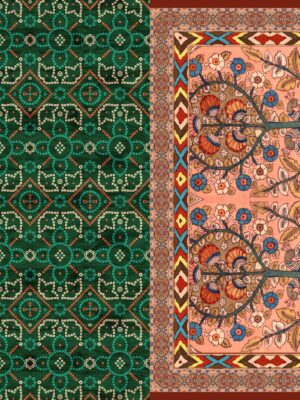
Visual Dispersion (Organic & Fluid Base): Replicating the technical parameters of the fine art branches of your catalog, the color fill within each individual geometric shape exhibits a textbook execution of “Aqueous Watercolor Bleed Dispersion.” Color is not flat or uniform; instead, the pigments drift naturally within their boundaries, generating soft water-stain pooling lines, granular sediment textures, and beautiful horizontal gradients. This perfectly simulates hand-painted gouache washes on high-absorbency rag paper.
-
Pigment Dispersion (Zonal Halftone Translucency): The design utilizes “Muted Contrast Partitioning.”
-
The Intersecting Halftones: The ink density transitions smoothly from high-opacity core zones down to translucent washes. When a gold module passes over an indigo column, the resulting overlay zone shifts into a soft teal halftone wash, requiring specialized digital textile setups or tonal screen separations to preserve the fluid watercolor effect.
-
The Spatial Grounds: The negative white space maintains an absolute crisp, zero-bleed vector perimeter around the floating clusters. This provides absolute spatial stability that pushes the intense geometric modules forward into sharp, luminous three-dimensional relief.
-
-
Edge Dispersion (Vector-Sharp Shape over Translucent Ground): The boundaries feature a highly disciplined “Hybrid Graphic Transition.” While the internal pigments melt into soft focus via fluid watercolor pooling, the outer contour profiles of the shapes are mathematically sharp and pristine. This complete lack of color bleeding at the shape perimeters ensures absolute structural integrity, making it effortless for your technical design operations to seamlessly tile the asset into a continuous mill run.










Reviews
There are no reviews yet.