


Description
-
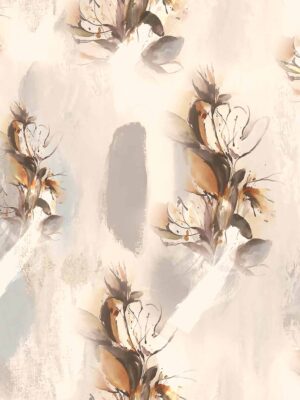
Visual Dispersion (Mechanical): The design exhibits a “Mud-Resist (Dabu) simulation Dispersion.” The pigments are applied to mimic the natural, irregular “cracking” that occurs when a mud-resist paste is dried on fabric before dyeing. This provides a tactile, weathered surface quality where the ground and motif pigments “bleed” into the micro-fissures, giving the design an authentic, hand-painted character.
-
Pigment Dispersion (Zonal): The design utilizes “Zonal Tonal Partitioning.”
-
The Motif Anchors: Utilize a “viscous-to-stippled” dispersion—maximum pigment density in the primary silhouettes that is intentionally “broken” by the ground-veins to simulate artisanal wear.
-
The Atmospheric Ground: Utilizes a “vaporous” dispersion, where the base tones are applied with varying mineral density to create a sense of subterranean movement behind the primary patterns.
-
-
Edge Dispersion (Friction-Organic Transition): The boundaries feature a “Defined-Friction Transition.” Form is defined by the energy of the block-strike rather than hard graphic lines. The perimeters of the lotus butis possess a soft-mottle dispersion, simulating the organic absorption of pigments on a hand-loomed ground.




Reviews
There are no reviews yet.