


Description
-
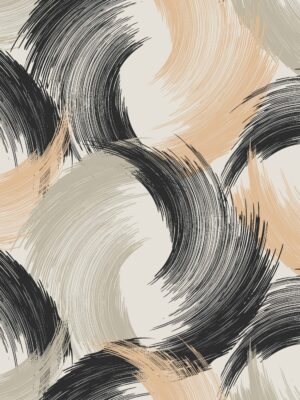
Visual Dispersion (Mechanical): The design exhibits “Viscous Scumble-Mottling Dispersion.” The pigments are dispersed as if applied with a wide palette knife or a flat, stiff-bristle brush, leaving behind fractured, granular edges characteristic of Impasto or Dry-Brush techniques.
This provides a tactile “raw” surface quality where color density is intentionally broken by the “tooth” of the stroke, mimicking the natural friction of heavy minerals meeting a drying mineral surface.
-
Pigment Dispersion (Zonal): The design features “Crystalline Linear Graduation.” Dispersion is strictly organized by “materiality.” The obsidian and deep teal blocks exhibit maximum, opaque saturation in their centers, immediately transitioning to a “scumbled” or “frayed” lower density at the perimeters where the tool lifts, mimicking the physical movement of heavy pigments meeting a textured substrate.
-
Edge Dispersion (Serrated-to-Grit): The boundaries of the forms feature a “Defined Transition.” While the primary rectangular paths maintain a sharp graphic direction to define the architecture, the application of color creates a subtle “grit” or “scraped” texture at the perimeters, ensuring the motifs feel hand-rendered rather than mechanically generated.







Reviews
There are no reviews yet.